Khóa học
IELTS Online
IELTS Online
Giảm đến 18%
Đăng ký ngay
Mục lục [Ẩn]
Khi ôn tập IELTS Reading, việc luyện kĩ năng giải đề qua các đề thi thật là một cách hiệu quả giúp bạn tăng band điểm nhanh. Bài viết này sẽ giúp bạn giải trọn vẹn đề thi thật IELTS Reading Innovation in Business với hệ thống đề bài, câu hỏi, đáp án chi tiết kèm giải thích rõ ràng. Đây sẽ là tài liệu hữu ích để bạn ôn luyện và nâng cao kỹ năng Reading, sẵn sàng chinh phục band điểm mục tiêu trong kỳ thi IELTS.
| Bạn đang ở band IELTS bao nhiêu? Làm bài test miễn phí và nhận ngay lộ trình học cá nhân hóa. 👉 Đăng ký test IELTS miễn phí ngay |
READING PASSAGE 3
You should spend about 20 minutes on Questions 27-40, which are based on Reading Passage 3 on pages 10 and 11.
Innovation in Business
Innovation describes the way that we develop new ideas, products, and approaches, and it is one of the most vital human endeavors. Over the history of humanity, innovation has made life better in so many different ways. It is part of human nature to recognize the benefits of innovation; however, the majority of us have little comprehension of the processes that actually lead to innovation occurring. This is a frequent topic for discussion in journals and university lecture theatres. However, in company boardrooms across New Zealand, the term is heard far too frequently, and more caution should be applied. Certainly, a recent international survey showed that the idea of innovation is so broad as to appear almost meaningless, with different sectors of the business world—or different divisions inside the same business—often defining innovation in their own way.
While there is an obvious attraction to the new, innovation is not always about large-scale research and development projects or revolutionary business models; it can be on a small, highly localized scale and involve a step-by-step approach. The famous case study of the drinks company Lucozade shows it can be as simple as adding a screw top to a bottle. This carefully managed change in packaging shifted the public perception of the product from a medicine to a sports drink, and Lucozade profited handsomely, clearly showing their approach was successful. So what steps can businesses take to keep ahead in the innovation game?
There seems to be a widespread belief that the world's best ideas are sudden and intuitive. Thomas Edison supposedly invented the light bulb with a sudden moment of clarity, but in fact, the book Edison: His Life and Inventions shows that Edison's own inspiration usually resulted from laborious experimentation, rather than a moment of genius. Thus, business managers are at risk of overestimating the pace of development while underestimating the amount of perseverance needed. This is why we must reject the false assumption that innovation is just a moment of brilliance waiting to strike.
No exploration of innovation is complete without mention of Steve Jobs, the late chief executive officer (CEO) of Apple. No one encapsulated the creative essence of Silicon Valley, the home of many global tech companies, better than Jobs, but he has also been accused of arrogance. Jobs' managerial approach often imitated his co-workers but, in part, it was the fuel for his visionary innovations. He felt it his duty to make society a better place, but his egotistical behavior could have undesirable consequences, too. Jobs' former employees have suggested this type of demanding behavior affects sickness rates and group morale, which in turn may squash creativity and innovation.
In his 2011 TED (Technology, Entertainment, Design) Talk, economist Tim Harford made this statement: "Show me a successful complex system, and I will show you a system that has evolved through trial and error." It sounds like common sense, and some commentators have claimed Harford's TED Talk was not persuasive because it was stating the obvious. But he responds that a trial-and-error approach is not all that obvious, because society expects all problems to have a quick and simple solution. Harford is right to point out that both consumers and investors expect consistent and clear breakthroughs. But the value of step-by-step innovation is often underrated, and failure may, in fact, be crucial to eventual success.
Former chief solutions officer at Yahoo, Tim Sanders, believes that innovation is only "little ideas that combine with other little ideas that improve themselves into game-changing ideas." This snowballing effect has similarities to the phenomenon that author and broadcaster Steven Johnson calls the "hummingbird effect" of innovation. This points out that progress in a specific area or discipline can end up triggering small but significant developments elsewhere entirely. A good case to cite in support of this universal truth would be Gutenberg's printing press, which was revolutionary in itself for making books accessible to the masses. However, the press also affected an unrelated industry by causing a rise in demand for reading glasses.
This highlights the wider idea of connectivity, which is an essential component of innovation. When Kode Biotech won a recent innovation award, CEO Steve Henry had this to say: "Most people think innovation is invention, but they don't understand that innovation is the conversion of invention into something useful." This is particularly true when it comes to Kode's highly specialized use of nanotechnology. Henry says that Kode cannot chase all the opportunities it has created. Instead, Kode's approach is to collaborate with similar nanotechnology businesses, which take its innovations and develop them into commodities that can be sold in the marketplace.
Innovation can be hectic and disorganized, but that is the way that radical new ideas sometimes come about. But, for established businesses, the disorderly nature of innovation can seem discouraging. Previously Unavailable, a specialist innovation consultancy, says that while 84% of businesses consider innovation critical to their future, only 6% are satisfied with their innovation efforts. Previously Unavailable uses a process called Black Box, which was developed following a study at Harvard Business School. Black Box was formed to overcome the barriers that prevent innovation in larger organizations. Using this unique system, Previously Unavailable will lease a team of innovation experts on a short-term basis to client organizations to assist with conceiving, developing, and launching new products and business innovations. It seems probable that this sort of innovation consultancy will become increasingly common, just as businesses already employ specialist consultants for legal, financial, or marketing services.
Questions 27-30
Do the following statements agree with the claims of the writer in Reading Passage 3?
In boxes 27-30 on your answer sheet, write:
27. Most people understand how innovation happens.
28. The word "innovation" is overused in business in New Zealand.
29. There are many interpretations of what innovation means in business, according to one global study.
30. Research and development projects have a higher priority today than in the past.
Questions 31-35
Choose the correct letter, A, B, C, or D. Write the correct letter in boxes 31-35 on your answer sheet.
31. What is the writer doing in the third paragraph?
A. Criticizing the conclusions of one publication
B. Praising the contribution of a famous inventor
C. Dismissing one common idea about innovation
D. Suggesting that innovation changes over time
32. What is the writer's main point in the fourth paragraph?
A. Each industry will innovate in its own way.
B. There are pros and cons to strong leaders.
C. Some individuals are more innovative than others.
D. Leadership requires building teams that work together.
33. The writer refers to Gutenberg's printing press in order to:
A. Compare how two different innovations developed.
B. Illustrate an exception to his point about innovation.
C. Show why one approach to innovation was correct.
D. Give an example of a general rule about innovation.
34. What is the writer's main point in the seventh paragraph?
A. Companies should cooperate to turn ideas into products.
B. A company tends to make profits from its own innovations.
C. Science and business can often have common goals.
D. Competition between businesses produces innovation.
35. According to the writer, companies like Previously Unavailable:
A. Have published valuable research about innovation.
B. Help companies recruit people with skills in innovation.
C. Run university courses teaching innovation skills.
D. Can be hired to give businesses advice about innovation.
Questions 36-40
Complete each sentence with the correct ending, A-G, below. Write the correct letter, A-G, in boxes 36-40 on your answer sheet.
36. A book about the life and work of Thomas Edison suggests that
37. People who have worked for CEOs like Steve Jobs claim that
38. Critics of Harford's 2011 TED Talk argue that
39. Steven Johnson's hummingbird effect proposes that
40. Kode Biotech CEO Steve Henry believes that
A. Innovators do not get enough credit for their own ideas.
B. Innovation may influence a completely different field.
C. Expressing what everyone already knows is pointless.
D. Innovation can be enhanced through collaboration with similar companies.
E. Innovation requires a great deal of hard work.
F. Copying ideas that already exist is not true innovation.
G. Certain personality types can limit innovation.
| Học mãi mà IELTS không lên band? Học thử IELTS miễn phí cùng giáo viên 7.5+, chấm chữa lỗi sai ngay lập tức. 👉 Đăng ký học thử miễn phí ngay |
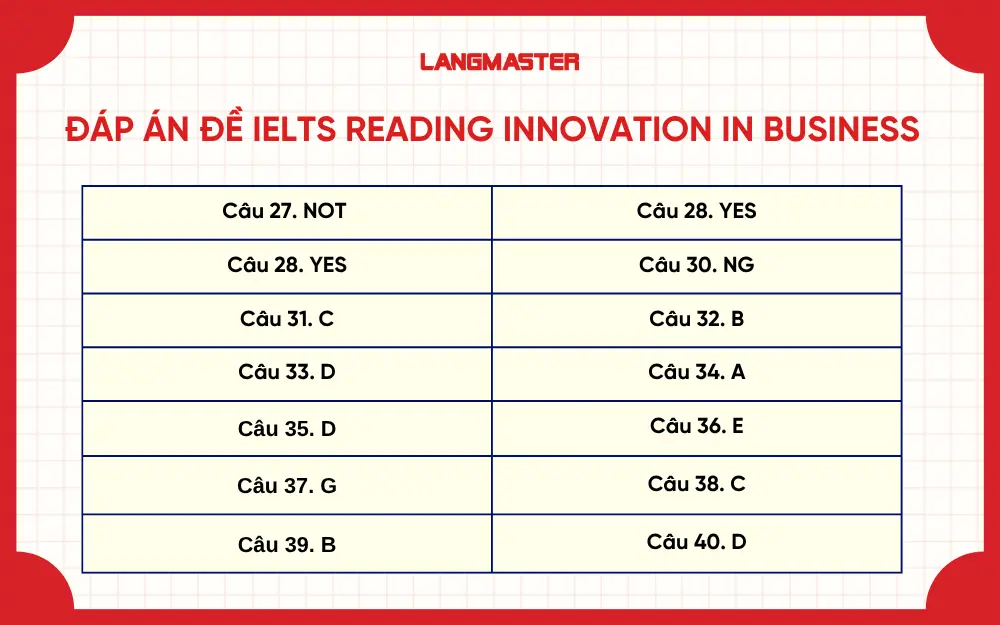
|
Câu 27. NOT |
Câu 28. YES |
|
Câu 28. YES |
Câu 30. NG |
|
Câu 31. C |
Câu 32. B |
|
Câu 33. D |
Câu 34. A |
|
Câu 35. D |
Câu 36. E |
|
Câu 37. G |
Câu 38. C |
|
Câu 39. B |
Câu 40. D |
GIẢI THÍCH CHI TIẾT
Câu 27: Đáp án: No
Thông tin trong bài: “...the majority of us have little comprehension of the processes that actually lead to innovation occurring.”
Giải thích: Tác giả khẳng định phần lớn mọi người ít hiểu biết về cách đổi mới diễn ra. Câu hỏi lại nói hầu hết mọi người hiểu rõ, trái ngược hoàn toàn với nội dung bài.
→ Kết luận: Phát biểu trong câu hỏi mâu thuẫn với ý kiến của tác giả → NO.
Câu 28: Đáp án – Yes
Thông tin liên quan: “…in company boardrooms across New Zealand, the term is heard far too frequently, and more caution should be applied.”
Giải thích: Cụm “heard far too frequently” có nghĩa là “được nhắc đến quá thường xuyên”, đồng nghĩa với “overused”. Tác giả cũng chỉ rõ điều này xảy ra “across New Zealand”.
→ Kết luận: Thông tin trong bài trùng khớp với phát biểu → YES.
Câu 29: Đáp án - Yes
Thông tin liên quan: “A recent international survey showed that the idea of innovation is so broad as to appear almost meaningless, with different sectors … defining innovation in their own way.”
Giải thích: Khảo sát quốc tế cho thấy mỗi lĩnh vực định nghĩa “innovation” theo cách riêng, chứng tỏ có nhiều cách hiểu khác nhau về khái niệm này trong kinh doanh.
→ Kết luận: Thông tin trong bài hoàn toàn đồng nghĩa với phát biểu trong câu hỏi → Đáp án: YES.
Câu 30. Đáp án: Not Given
Thông tin liên quan: “Innovation is not always about large-scale research and development projects … it can be on a small, highly localized scale.”
Giải thích: Đoạn văn chỉ nêu rằng đổi mới không nhất thiết phải gắn với các dự án R&D quy mô lớn, mà có thể diễn ra ở quy mô nhỏ và mang tính địa phương. Tuy nhiên, không có thông tin nào so sánh mức độ ưu tiên của R&D giữa hiện tại và quá khứ.
→ Kết luận: Không có dữ kiện xác nhận hay phủ định phát biểu → Đáp án: NOT GIVEN.
Câu 31: Đáp án C
Thông tin liên quan: “There seems to be a widespread belief that the world's best ideas are sudden and intuitive… we must reject the false assumption that innovation is just a moment of brilliance.”
Giải thích: Tác giả chỉ ra rằng nhiều người tin đổi mới đến từ “khoảnh khắc thiên tài”, nhưng ngay sau đó khẳng định phải bác bỏ giả định sai lầm này. Hành động này thể hiện việc phủ định một quan điểm phổ biến về đổi mới sáng tạo.
→ Kết luận: Tác giả bác bỏ một quan niệm phổ biến về innovation → Đáp án: C. Dismissing one common idea about innovation.(Bỏ qua một ý tưởng phổ biến về sự đổi mới.)
Câu 32. Đáp án B
Thông tin liên quan: “Jobs … has also been accused of arrogance… but it was the fuel for his visionary innovations… this behavior affects sickness rates and morale, which in turn may squash creativity and innovation.”
Giải thích: Đoạn văn trình bày hai mặt đối lập trong phong cách lãnh đạo của Steve Jobs:
→ Kết luận: Tác giả cho thấy lãnh đạo mạnh mẽ vừa có lợi vừa có hại → Đáp án: B. There are pros and cons to strong leaders. (Có những ưu và nhược điểm của những nhà lãnh đạo mạnh mẽ.)
Câu 33. Đáp án D
Thông tin liên quan: “A good case to cite … Gutenberg’s printing press … However, the press also affected an unrelated industry by causing a rise in demand for reading glasses.”
Giải thích: Tác giả sử dụng ví dụ về máy in của Gutenberg để minh họa rằng một đổi mới trong một lĩnh vực có thể tạo ra tác động ngoài dự kiến ở một lĩnh vực khác. Đây là ví dụ cụ thể chứng minh nguyên lý chung về sự lan tỏa và tác động gián tiếp của đổi mới sáng tạo.
→ Kết luận: Ví dụ được đưa ra để minh họa cho một quy luật tổng quát về innovation → Đáp án: D. Give an example of a general rule about innovation. (Đưa ra ví dụ về quy tắc chung về đổi mới.)
Câu 34: Đáp án A
Thông tin liên quan: “Kode’s approach is to collaborate with similar nanotechnology businesses, which take its innovations and develop them into commodities that can be sold.”
Giải thích: Tác giả khẳng định Kode Biotech đạt được thành công nhờ hợp tác với các doanh nghiệp cùng lĩnh vực, giúp chuyển đổi ý tưởng sáng tạo thành sản phẩm thương mại.
→ Kết luận: → Đáp án A. Companies should cooperate to turn ideas into products. (Các công ty nên hợp tác để biến ý tưởng thành sản phẩm.)
Câu 35: Đáp án D
Thông tin liên quan: “Previously Unavailable … will lease a team of innovation experts … to assist with conceiving, developing, and launching new products and business innovations.”
Giải thích: Công ty này cung cấp đội ngũ chuyên gia đổi mới sáng tạo làm việc tạm thời để hỗ trợ doanh nghiệp phát triển sản phẩm mới.
→ Kết luận: → Đáp án D. Can be hired to give businesses advice about innovation. (Có thể được thuê để mang lại lợi ích cho doanh nghiệp về đổi mới)
Câu 36: Đáp án E
Thông tin liên quan: “Edison’s own inspiration usually resulted from laborious experimentation, rather than a moment of genius.”
Giải thích: “Laborious experimentation” nghĩa là thử nghiệm kiên trì, vất vả, chứng tỏ đổi mới đòi hỏi nhiều công sức và nỗ lực, không phải sự lóe sáng tức thì.
→ Kết luận: → E. Innovation requires a great deal of hard work. (Sự đổi mới đòi hỏi rất nhiều nỗ lực.)
Câu 37: Đáp án G
Thông tin liên quan: “This type of demanding behavior affects sickness rates and group morale, which in turn may squash creativity and innovation.”
Giải thích: Nhân viên cho rằng phong cách lãnh đạo khắt khe và cái tôi cao có thể làm giảm tinh thần, hạn chế sáng tạo và đổi mới.
→ Kết luận: G. Certain personality types can limit innovation. (Một số loại tính cách có thể hạn chế sự đổi mới.)
Câu 38: Đáp án C
Thông tin liên quan: “Some commentators have claimed Harford’s TED Talk was not persuasive because it was stating the obvious.”
Giải thích: “Stating the obvious” nghĩa là nói điều ai cũng biết, tức trình bày điều hiển nhiên, không thuyết phục.
→ Kết luận: C. Expressing what everyone already knows is pointless. (Việc diễn đạt những điều mà mọi người đều đã biết là vô nghĩa.)
Câu 39: Đáp án B
Thông tin liên quan: “…progress in a specific area or discipline can end up triggering small but significant developments elsewhere entirely.”
Giải thích: Hiệu ứng “hummingbird” nói rằng tiến bộ trong một lĩnh vực có thể dẫn đến tác động ở lĩnh vực khác hoàn toàn.
→ Kết luận: B. Innovation may influence a completely different field. (Sự đổi mới có thể ảnh hưởng đến một lĩnh vực hoàn toàn khác.)
Câu 40: Đáp án D
Thông tin liên quan: “Kode’s approach is to collaborate with similar nanotechnology businesses … which take its innovations and develop them into commodities.”
Giải thích: Steve Henry nhấn mạnh rằng hợp tác với các công ty tương tự giúp mở rộng và ứng dụng hiệu quả các đổi mới sáng tạo.
→ Kết luận: D. Innovation can be enhanced through collaboration with similar companies. (Sự đổi mới có thể được tăng cường thông qua sự hợp tác với các công ty tương tự.)
>> Xem thêm:
Trong 4 kỹ năng của kỳ thi IELTS, Reading luôn là “thử thách lớn” đối với phần đông thí sinh. Bài thi này không chỉ đòi hỏi vốn từ vựng học thuật sâu rộng, mà còn yêu cầu tốc độ xử lý thông tin nhanh, tư duy phân tích logic, và khả năng nắm bắt ý chính trong thời gian giới hạn. Mỗi dạng câu hỏi lại có chiến thuật riêng, nếu không được luyện tập đúng hướng, thí sinh rất dễ mất điểm ở những chi tiết tưởng như đơn giản.
Để nâng cao kỹ năng Reading và đạt band điểm mục tiêu, người học cần có lộ trình học rõ ràng, phương pháp rèn luyện hiệu quả cùng sự kèm cặp sát sao từ giảng viên giàu kinh nghiệm. Chính vì thế, ngày càng nhiều học viên tin chọn khóa học IELTS online tại Langmaster – nơi mang đến trải nghiệm học tập cá nhân hóa, giáo trình chuẩn đề thi thật và sự hỗ trợ tận tâm từ đội ngũ chuyên gia.

Ưu điểm nổi bật của khóa học:
Đặc biệt: Học viên được HỌC THỬ MIỄN PHÍ trước khi đăng ký chính thức. Đây là cơ hội để bạn trải nghiệm phương pháp giảng dạy và thấy rõ sự khác biệt ngay từ buổi đầu.
KẾT LUẬN: Như vậy, Langmaster đã vừa cùng bạn phân tích và giải chi tiết đề IELTS Reading chủ đề Innovation in Business. Bài viết đã chỉ rõ các kỹ năng cần thiết để tìm thông tin, nhận biết từ khóa và áp dụng chiến lược đọc hiểu hiệu quả. Hy vọng những kiến thức này sẽ giúp bạn tự tin hơn khi làm bài và cải thiện điểm số Reading IELTS. Chúc bạn học tập hiệu quả và đạt kết quả cao trong kỳ thi IELTS sắp tới!



Các dạng bài phổ biến và tiêu chí chấm điểm IELTS Reading chi tiết nhất: Multiple Choice, Matching Information, Matching Headings,... và hướng dẫn chiến lược làm bài hiệu quả
Những sai lầm khi luyện IELTS Reading bao gồm: dịch từng từ, đọc hết cả bài, không đọc câu hỏi trước, không quản lý thời gian, không nắm vững kỹ năng paraphrase, viết sai chính tả
![Giải đề IELTS Reading: A brief history of humans and food [full answers]](https://langmaster.edu.vn/storage/images/2025/09/20/a-brief-history-of-humans-and-food-ielts-reading-answers.webp)
Giải đề thi IELTS Reading “A brief history of humans and food” kèm full đề thi thật, câu hỏi, đáp án, giải thích chi tiết, và từ vựng cần lưu ý khi làm bài.

Tổng hợp IELTS Reading tips hay nhất giúp bạn đọc nhanh, nắm ý chính và xử lý thông tin chính xác, tự tin đạt điểm cao trong kỳ thi IELTS.
![Giải đề IELTS Reading: The importance of law [Full answers]](https://langmaster.edu.vn/storage/images/2025/09/22/55.webp)
Giải đề IELTS Reading “The importance of law” kèm đáp án chi tiết, từ vựng quan trọng và bí quyết luyện thi hiệu quả để nâng cao band điểm.




Hơn 16 năm kinh nghiệm, đào tạo thành công 800.000+ học viên
Phương pháp giảng dạy hiện đại, học viên tiến bộ rõ rệt
Lộ trình học chuẩn quốc tế, phù hợp với nhu cầu thực tiễn
Giáo viên đạt chuẩn Quốc tế với chất lượng top đầu thị trường, giàu kinh nghiệm
Học online linh hoạt, cam kết đầu ra bằng văn bản